



Deep Roots, Bold Future
At 90 years old, the UC Davis Arboretum and Public Garden builds on its legacy of innovation to help create a more resilient future
Visit the 100-acre UC Davis Arboretum on any weekday morning, and you'll likely find an ecology class studying wildlife, student interns tending a garden they designed, or a parent pointing out a beautiful flower to a child — most unaware of the programs and planning behind the scenes that make it all possible.
This is what the Arboretum has always been: a joyful manifestation of a community of scientists, gardeners, educators and lifelong learners — and, for just as many people, simply a place to slow down and enjoy nature. This did not happen by accident.
"The Arboretum feels timeless, but it didn't occur through happenstance. Generations of faculty, staff, students and community members have intentionally shaped it into a place where education, conservation and public life come together. That's a legacy that's benefited UC Davis, and the Arboretum is now a crown jewel of the entire region,” said Lucas Frerichs, Yolo County supervisor.
The Arboretum began as a unique, underfunded garden, and faculty and staff built on that constraint with intention, turning cutting-edge horticultural knowledge and continual innovation in community engagement into a world-class living museum, vital to the university's mission. They solved the problems in front of them: which plants could survive here with little water and how to keep a hundred acres running on a small budget. In solving these and other challenges, they built something more valuable than a beautiful garden: expertise, innovation and partnerships that, decades later, continue to reap rewards.
The real story of the Arboretum's 90th year is what those 90 years have generated.

Help Us Celebrate 90 Years!
Dive into the Arboretum's full history, see what's happening on campus to mark the milestone, and add your own story to the mix. Visit the 90th anniversary webpage to explore it all.
Want to help write the next chapter? Become a member or explore other ways to support the Arboretum and Public Garden.

Tested here first: Arboretum All-Stars
It starts with the plants themselves. For decades, Arboretum staff had to know which plants could perform well in California's Central Valley with its punishing summer heat, alkaline soil, wind, and a primitive irrigation system. That practical need aligned with UC Davis' longstanding leadership in plant and horticultural sciences and a genuine desire to help people garden well with fewer resources. Together, those forces produced the Arboretum All-Stars program, a curated list of low-water, high-performing plants, built from years of field testing that no laboratory study or single growing season could replicate.
What began as a practical answer to a tight budget has become something the region actively needs as Central Valley summers grow hotter and drier and species that thrived for generations start to struggle. Homeowners, city planners and landscape architects across California now turn to All-Stars.
Last year, marking the program's 20th anniversary, staff updated the list with exactly those challenges in mind, continuing a tradition of adapting to change.
Building resilience across campus

The success of the All-Stars reflects a simple principle that nothing gets recommended until it's proven on the ground by the people charged with its long-term care. Today, that same approach guides the stewardship of the entire campus landscape.
In 2011, then–Vice Chancellor John Meyer called on the Arboretum to expand its work to the entire campus — and the organization was renamed the UC Davis Arboretum and Public Garden to reflect its broader mandate of turning the whole campus into a public garden. During a 2012 visit, the late, world-renowned botanist Peter Raven praised the effort as a potential "modern Garden of Eden" that had "brought a spirit to the campus."
Drawing on its experience growing plants for a changing climate, and in partnership with UC Davis academics and Campus Planning, the Arboretum and Public Garden developed the Living Landscape Adaptation Plan, or LLAP, a roadmap for making the campus resilient to future climate projections. The LLAP extends that same test-here-first discipline to every corner of university land, anticipating hotter conditions, an aging tree canopy, shrinking water supplies and new pest pressures before they arrive, rather than reacting once they do. It asks a campus-scale version of the same question All-Stars has always asked: Given a changing climate, what should we plant today to keep the campus’ leafy, tree-lined character for future generations?
"What the Arboretum figured out on a hundred acres, we are continuing to extend to the entire campus," said Clint Lord, associate vice chancellor of Facilities Management. "There's really only one landscape here, and we need to care for it sustainably, with an eye toward what it will require decades from now."
That thinking shows up in plant choices and in water management alike.


Arboretum and Public Garden horticulturists work with campus landscape architects to recommend trees and plants — including many from the All-Stars list and a new list of climate-ready trees — for landscapes around campus. New building or construction projects incorporate low-water, climate-adapted plantings.
The Arboretum Waterway shows the same approach. After the North Fork was cut off from Putah Creek in 1948, it became the largest component of the campus stormwater management system. An extensive multi-year renovation — funded by the campus, a major state grant, and an outpouring of community donor support — added earthen banks for wildlife habitat, created flow to improve water quality, and increased flood capacity to handle a more volatile climate with larger, more unpredictable storms.
A Window Into the University's Work
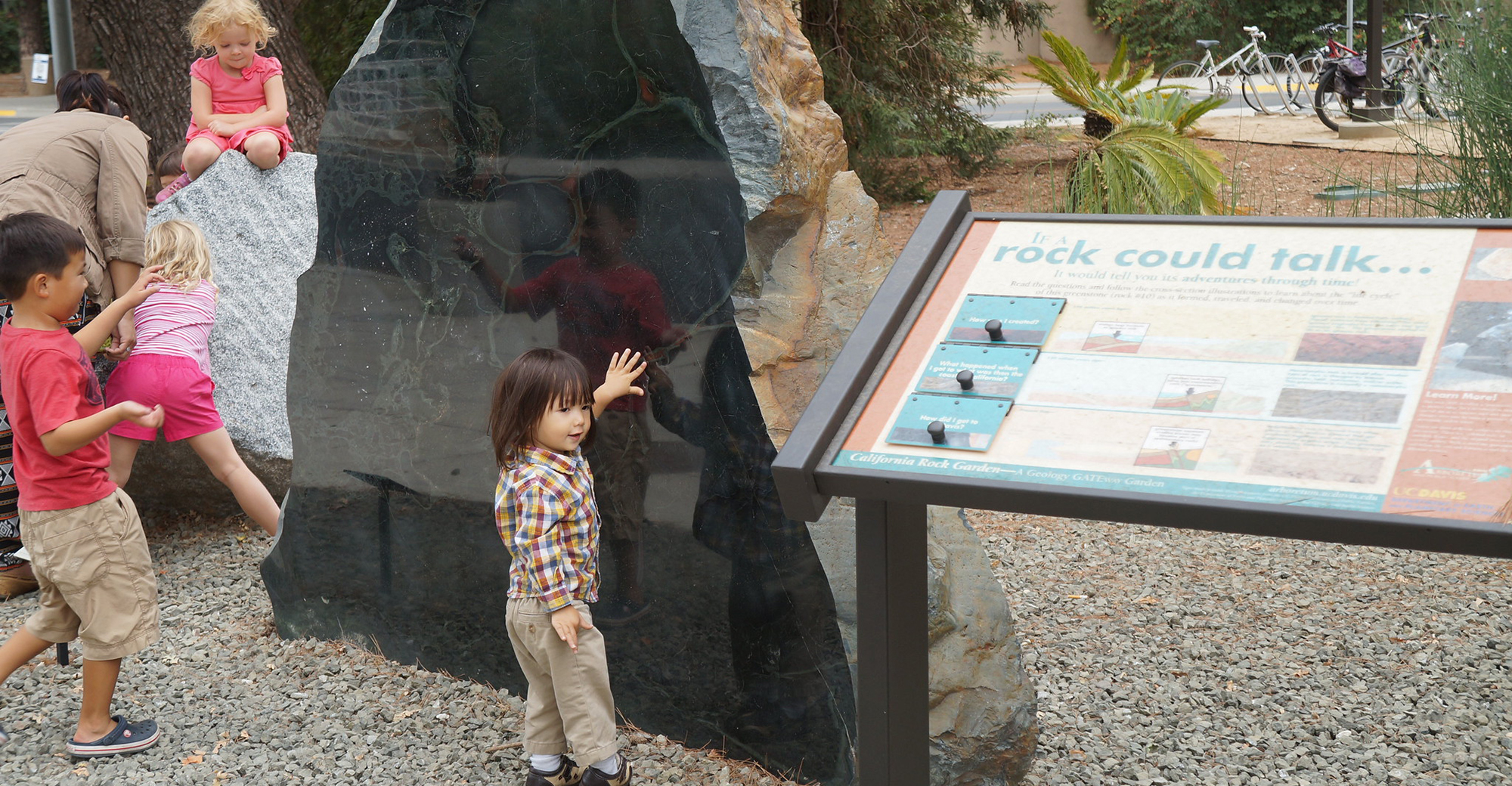
If the LLAP is about stewarding the entire campus landscape, the UC Davis GATEways Project is about learning from it. The project was inspired by a 1999 report from a national commission of land-grant university presidents, "Returning to Our Roots: The Engaged Institution," which argued that universities like UC Davis had drifted from part of their founding purpose — spreading knowledge beyond campus walls. It urged them to make public engagement central to their missions again.
Since 2006, the GATEways Project (Gardens, Arts, and The Environment) has used visitors’ affinity for the Arboretum to bring the university's teaching and research alive. Arboretum experts co-created gardens and programs with academic partners to showcase their work. Now about a dozen GATEway Gardens in all, they include the Animal Science and Geology GATEway Gardens adjacent to the Arboretum.
Newer GATEway Gardens, like the Savageau Courtyard at Cruess Hall, are extending that same engagement to the rest of campus — proving that the model works in locations that don't come with the Arboretum's built-in pull. This approach has become a model for other institutions, including Smithsonian Gardens in Washington, D.C.


Nature as an essential resource

Starting in 2020, the COVID-19 pandemic even further highlighted the Arboretum’s role as an essential meeting space, connecting people to nature and to one another.
That time sharpened an idea already forming at the Arboretum and the university: As student mental health becomes a greater challenge in higher education, including at UC Davis, a connection to nature could be part of the solution. What emerged is Nature Rx, an initiative that treats campus outdoor spaces as a resource to improve mental and physical health and well-being through online resources and thoughtfully designed spaces.
One part of that effort has taken a clinical form: In partnership with Student Health and Counseling Services and Healthy UC Davis, campus healthcare providers can now formally prescribe time outdoors — typically at least 120 minutes a week in the Arboretum or other outdoor spaces — as part of a student's care plan. The science isn't new, though the evidence keeps growing: Time in green space is reliably linked to lower stress, better sleep and improved mental health, among many other benefits. Arboretum and Public Garden staff have expanded on this work further, serving in leadership roles in the international Campus Nature Rx Network, founded by Cornell University, helping other colleges and universities integrate nature into student well-being strategies and campus life.
“In my work, I routinely see the need for programs like this,” said Sydney Holmes, mental health promotions specialist with UC Davis Student Health and Counseling Services. “Between academic pressures and the challenges of adjusting to life in a new place, many students struggle with mental health issues. Programs like this that focus on evidence-based strategies to improve mental health are a huge asset to our whole campus community.”
Developing the next generation of environmental leaders
If Nature Rx addresses what students need right now, the Arboretum has an equally long history of preparing them for what comes after graduation. Research shows that students who get high-quality, hands-on experience in college are consistently more successful afterward, and higher-education researchers argue universities should offer more of it. As a university museum, the Arboretum has long given students leadership opportunities, but in the past those chances were only able to be offered to a single student at a time or through brief, quarter-long internships.
Then, growing out of the UC Davis GATEways Project and the same national push for land-grants to re-engage their public mission, the Arboretum built the Learning by Leading program, now a nationally recognized environmental leadership program. At the heart of the program is a cycle of mentorship: Expert staff mentor student leaders, who then mentor larger groups of interns who can then become leaders of a future team of students. Knowledge, experience, and responsibility pass from one cohort to the next, continuously, as they design and build climate-ready gardens, grow All-Star and native plants for the nursery, restore riparian plants to the waterway banks, develop Nature Rx programs for the public, and more.
Students leave a lasting mark on the Arboretum, campus landscapes, and visitors, but they're changed by the process too.
“Learning by Leading helped me realize my potential. I came into the program not fully recognizing what I was capable of, but through the support of my mentors and teammates I gained confidence, found my voice and discovered strengths I didn't know I had. The experience changed the way I see myself, and that's something I'll carry with me long after graduation,” said Luz Robles, '26, B.S. Agricultural and Environmental Education.
Learning by Leading is built around students becoming professionals, building leadership and technical skills, plus the harder-to-teach “soft skills” including communication, teamwork, and delegation. More than 1,000 students have gone through the program, many going on to environmental leadership roles.


Community engagement grows support
The Arboretum has thrived for 90 years because people have chosen, again and again, to invest in it, and that tradition remains as strong today as ever. The Friends of the UC Davis Arboretum and Public Garden, UC Davis' oldest support group, has backed the organization since 1971, turning memberships and plant sale revenue into beautiful plant collections, a robust volunteer program, innovative public programming, and student leadership development. Community volunteers contribute more than 25,000 hours of service each year, weeding, propagating plants and mentoring students. Generous donors support the organization through tribute gifts, annual campaigns, transformative endowments and planned gifts.
That tradition of giving reached a new scale this year with the largest gift in the Arboretum and Public Garden’s 90-year history: a $3.7 million estate gift from the late Cate McGuire, an Arboretum student intern in the 1970s, and her husband, Michael Smith. The gift will support the Learning by Leading program.
"This organization would not be what it is today without the generous support from donors and the community throughout our history," said Carmia Feldman, director of the UC Davis Arboretum and Public Garden. "They are our partners in making a difference in the world and joining in our mission to inspire human potential to help people and environments thrive."

Growing into the next 90 years
Arboretum and Public Garden staff share the innovative models they’ve tested over the years at conferences and consult for other institutions facing the same climate and engagement questions that planning documents and programs like the LLAP and GATEways help answer. The Learning by Leading model has also spread well beyond Davis, adopted by university gardens across the country and internationally, whose teams now meet as a community of practice to support each other and share innovations. The program earned the 2024 Program Excellence Award from the American Public Gardens Association. And Arboretum All-Stars plants, sold through the Arboretum's own teaching nursery, now grow climate resilience into yards and parks throughout the Central Valley and beyond.
Many examples, one pattern: Develop a model that provides solutions and expands impact here, then share it. These models work even as the problems change. Climate change is rewriting which plants are able to grow sustainably in the Central Valley. Communities across California are looking for green space that supports the health of people and the environment. And more than ever, we need experienced leaders. These issues drive the work of the Arboretum as a world-class living museum — now and into the future.
Perhaps recently retired Arboretum and Public Garden Director and Assistant Vice Chancellor Kathleen Socolofsky said it best: "Over the decades, our goal was never simply to create beautiful gardens — it was to create enduring models that connect people, landscapes, learning, and community in support of UC Davis' public service mission as a land-grant university. Seeing those ideas continue to evolve through the creativity and leadership of today's team gives me great confidence that the Arboretum and Public Garden's greatest contributions are still ahead."